
The Short Answer
Identify how water is reaching the floor before choosing a coating. Moisture within the slab, condensation on its surface, and water entering through a leak call for different assessments.
Where Is The Moisture Coming From?
New concrete can retain construction moisture. A slab on ground may also be affected by conditions below it. At the surface, a cool slab can collect condensation when conditions reach the dew point. Visible seepage at a joint, crack or perimeter calls for investigation of the water source.
Conceptual cross-section of the concrete slab and base. Probe depth and testing conditions are set by the applicable method and slab configuration.
What to look for: The blue drops sit on the surface. The probe is shown in a sleeve inside the concrete, with a yellow mark at the sensing point. It measures relative humidity inside the slab.
View full-size diagram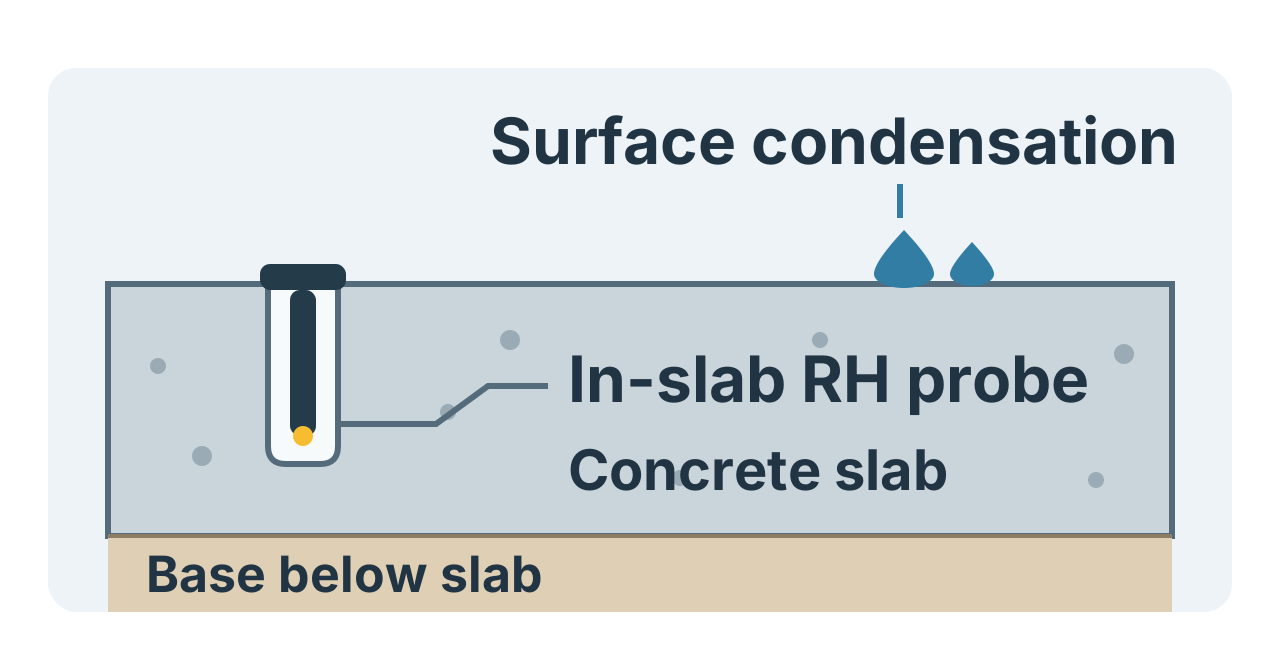
What The Tests Tell You
In-Slab Relative Humidity
ASTM F2170 uses probes to determine relative humidity within the concrete. The result is expressed as a percentage of relative humidity and describes the locations tested at the time of testing.
Calcium Chloride
ASTM F1869 measures the moisture vapour emission rate from the concrete subfloor surface under the test conditions. The result is expressed as a rate.
These methods measure different properties. Compare results with the written criteria for the specified primer and complete flooring system. A surface meter can help screen for areas of concern. Confirm which method the specification accepts for an installation decision.
When A Moisture Mitigation System Comes Up
If results exceed the proposed system’s acceptance criteria, ask the installer to explain the options and the conditions for each. A quote that includes a moisture-vapour barrier should identify the product, where it is used, how the slab will be prepared and which flooring layers are compatible with it.
Bring up active leaks, standing water and unexplained wet areas as separate items. Confirm who will investigate and address the source before coating. If a standard is cited, check its scope. For example, ASTM F3010 addresses certain membrane-forming systems under resilient floor coverings. For a resinous floor, check the written acceptance criteria of the complete proposed system.
How To Read A Sample Test Report
These fictional readings illustrate the fields in a report. They do not represent an Epoxology project or establish a pass/fail limit.
- Method
- ASTM F2170, in-slab relative humidity
- Location A
- Centre of warehouse bay · 78% RH
- Location B
- Near loading-door side · 87% RH
- Acceptance criteria
- Check the current written specification and technical data for the named primer or moisture treatment and complete assembly. Confirm which method and conditions apply.
- Decision record
- Record the applicable limit, the findings for each location, and who authorizes work to proceed.
Before interpreting the numbers, look for the test date, location plan, slab and ambient conditions, and evidence the specified method was followed. If the quotation names a mitigation system, ask for its own written acceptance criteria.
What To Ask For In Writing
- Which test is required, and what were the readings and locations?
- What are the stated acceptance limits and conditions for the proposed system?
- Who decides whether work can proceed if results change or water is found?
Can You Tell By Looking At The Slab?
Appearance helps identify places to investigate. A dry-looking surface alone does not establish that the slab meets a product’s moisture criteria.
Use the Flooring Assessment Checklist to note damp spots and gather any previous moisture test results before the assessment.
Technical References
- ASTM F2170 In-Slab Relative Humidity
- ASTM F1869 Moisture Vapour Emission Rate
- ACI Guide To Slabs Receiving Moisture-Sensitive Flooring
- ASTM F3010 Scope For Resilient Floor Coverings
- Sika Guide To Surface Conditions And Dew Point